SEE IT
Meet the idea before the symbol
A number begins as something the child can see, make, move, and compare. The written numeral comes when it has something to mean.
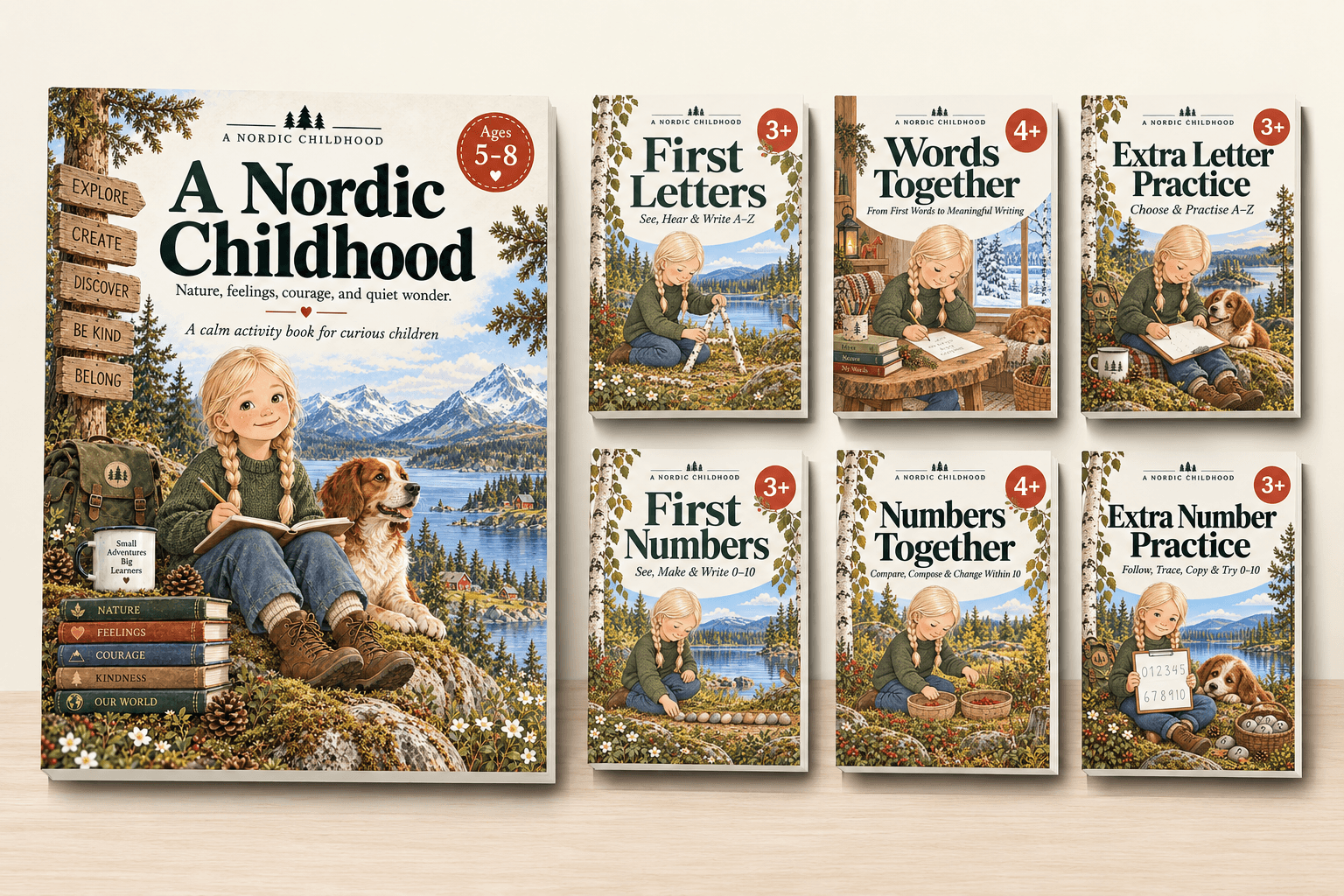
A NORDIC CHILDHOOD: THE LEARNING COLLECTION
A Nordic printable collection for early numbers, letters, meaningful writing, nature, and feelings. Choose what fits your child today. Leave the rest for later.
WHY NORDIC?
What, if anything, might that have to do with childhood?
Finland, where I grew up, has now been ranked the world's happiest country for nine years in a row.
I do not believe there is a secret Nordic formula for happiness. And no book can promise a happy childhood. But I do believe it is worth looking at what a Nordic childhood can make room for: time outdoors, ordinary independence, feelings that can be named, quiet courage, and enough rather than more. Those ideas shaped this collection.
Source: World Happiness Report 2026. Rankings reflect how residents evaluate their lives, averaged across 2023 to 2025.
Rooted in Nordic childhood. Made for families everywhere.
SEE THE PROGRESSION
Three real pages. Three parts of the same idea: begin with meaning, offer support, then make room.
SEE IT
A number begins as something the child can see, make, move, and compare. The written numeral comes when it has something to mean.
HEAR AND FORM IT
See the letter. Hear a useful sound. Follow the movement with a finger, trace once, then make an attempt without the path.
MAKE IT MATTER
A first word can name something. A caption can preserve a moment. A message can reach another person. Neatness can come later.
A Quiet Start is a free sampler made from a small selection of real pages in the collection. Ask me for a copy, then print the page that feels most relevant today.
One sampler cannot predict which of the 313 pages will interest your child. It can show you the tone, instructions, and approach before you decide.
Your sampler is sent whether or not you choose the five-day email series. By submitting, you agree that we may use your email address to deliver the sampler. Read the privacy notice.
Sixteen dedicated keepsake pages leave room for a name, age, date, the child's own marks, and sometimes their exact words.
These are ordinary printable pages. No special ink that fades. No wipe-clean surface that returns the page to blank. When a child makes a first word or draws five in their own way, the mark can remain.
You do not need to save everything. Keep the few pages that still feel like the child years later.
Some handwriting books use a physical groove, sometimes called a furrow, to keep the pencil on one fixed track. The pages in this collection use support differently.
The child first follows a large pale path with a finger. Next comes one guided trace. Then the path disappears, leaving open space for the child's own attempt.
The aim is not a row of identical marks. It is to help the child feel the movement, recognise the shape, and begin making it without the path.
WHAT IS INSIDE
Begin with the part that fits your child now. The books belong together, but they do not have to be used in order or all at once.
THE HEART
Nature, feelings, courage, handwriting, poems, reflection, and open pages.
Return to it when a season, question, or feeling makes one page relevant.
THE NUMBER PATH
See and make quantities before beginning to write numerals 0 to 10.
Compare amounts, find parts of a whole, and notice what changes when groups are joined or separated.
THE LETTER AND WORD PATH
Meet print letters through shape, sound, finger movement, and the child's own name.
Let first words become labels, captions, notes, signs, and messages.
The complete printable collection, 313 pages for US $29 once.
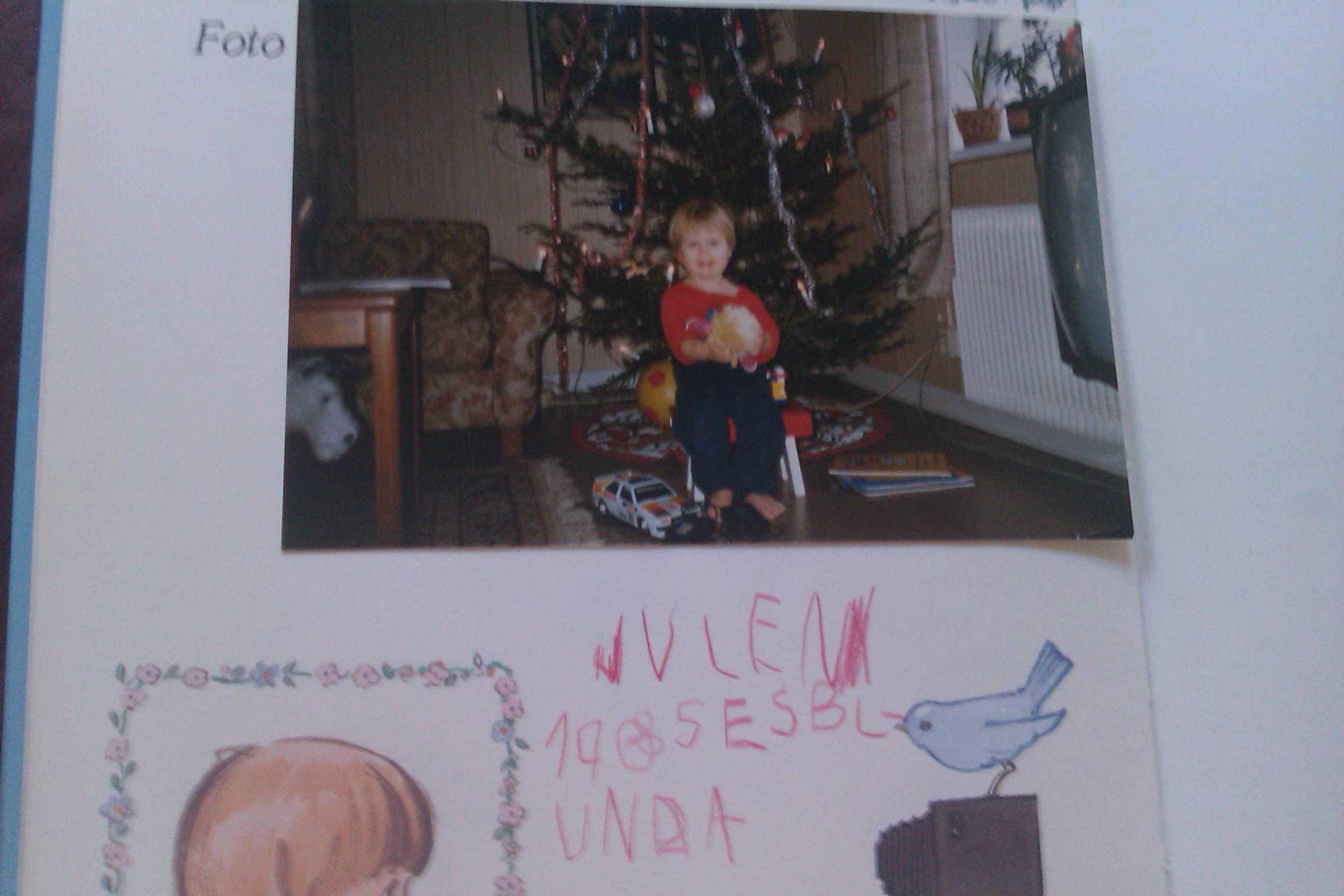
The page beside this story is from Christmas 1985, when my son Fredrik was two. It says “Julen 1985, Esplunda,” the place where we lived.
Three years later, Fredrik wrote a letter to his grandmother. It had several pages. I remember it. For years I was sure I had a photograph of it, and I may still have the original somewhere. But I cannot find either now.
The Christmas page survived. The letter may still be in a box somewhere, but for now it exists only in memory.
That difference sits quietly behind this collection.
Most practice pages can do their work and go. But sometimes a page carries more than the skill being practised. A first name. A number drawn in the child's own way. A thought they wanted someone else to know.
I cannot tell you which pages those will be.
You will know when one feels like your child.
This is a new collection, so there are not yet enough customer reviews to make broad claims about results.
You should not have to rely on claims.
You can look at real pages, see how the learning progresses, read exactly what is included, and begin with the free sampler if you prefer.
The examples on this page come from the books you receive.
See where the support begins, how it changes, and where the child tries alone.
Page counts, formats, printing help, household terms, and the price are stated plainly.
No study can tell you exactly how your child will respond to this collection, or any collection of learning books.
Research can still help us decide what support to offer, what not to overuse, and what should come next.
In one study, five-year-olds learned unfamiliar symbols in six different ways. Children who saw varied examples later recognised new versions of those symbols better than children who learned from highly similar forms. Handwriting is one way children naturally produce that useful variation.
A separate study found that a reading-related brain network was recruited after five-year-olds printed letters, but not after they typed or traced them.
Neither study tells us that a workbook page will teach a child to read. They do give us a reason to move beyond repeated tracing and leave room for the child's own attempt.
That is why these pages use Follow, Trace, Try. The path helps at first. Then it disappears.Guidance from the Institute of Education Sciences recommends teaching early number and operations through a developmental progression.
It also encourages helping children notice and describe mathematics in the world around them, although the evidence supporting that second recommendation is more limited.
That thinking informed pages where children see, make, move, compare, join, and separate quantities before a written numeral carries the whole task.One digital collection to draw from as your child becomes interested in numbers, letters, words, nature, feelings, and making marks of their own.
Nature, feelings, courage, quiet observation, and Nordic ways of seeing childhood.
Seeing, making, and writing quantities from 0 to 10.
Comparing, composing, joining, separating, and changing quantities within 10.
Shape, sound, letter formation, and the child's own name.
Words, labels, captions, notes, signs, and messages.
14 pages for repetition when it is useful.
28 pages for repetition when it is useful.
Four pages explaining how to choose and print a page.
Print only what fits today. Return to the rest when it becomes useful.
Open the question that matters now. Leave the rest for later.
Begin with what your child is already noticing.
If they are counting fingers, stones, or steps, try an early number page. If they are asking about a letter in their name, begin there. If they want to make a sign, label a drawing, or write something to another person, open Words Together.
The collection provides paths, but you do not have to follow every page in order.
Some early number and letter pages can be shared from around age three through looking, listening, counting, movement, and finger-following. Pencil work can wait.
The later books become useful as the child begins comparing quantities, recognising letters, making words, or wanting writing to carry a message.
These are entry points, not deadlines. Choose by readiness and interest rather than trying to match every page to an age.
No.
The earliest pages begin with looking, listening, pointing, speaking, moving objects, drawing, and following a path with a finger. Independent letters, numerals, words, and messages come later.
No. Please do not treat 313 pages as an instruction to print 313 pages.
Use the PDF bookmarks and page ranges to find what fits today. Print one page or a short group. Leave the rest in the collection until it becomes useful.
A younger child will need help choosing a page, understanding the short instruction, and getting started. Many pages use only a pencil, crayons, fingers, movement, or a few ordinary objects.
Some children may continue independently once they understand the page. Others will want you nearby. The collection does not promise that every page will hold every child without help.
Leave it.
One page cannot tell you how your child will respond to the rest of the collection. A child who ignores a number page may be interested in a letter from their name, a picture to label, a feeling to talk about, or a place to draw something entirely their own.
There is no need to finish a page simply because it was printed.
No. It is a home learning collection and supplement.
It can support early numbers, letters, writing, observation, reflection, and conversation, but it does not replace school, a complete homeschool curriculum, specialist assessment, or individual support.
No.
Nordic words, landscapes, and ideas give the collection its character. Nature, feelings, courage, enoughness, numbers, letters, and meaningful writing belong to children everywhere.
Yes. Personal household use includes the children in your household, and you may print pages again for them.
The files may not be shared, uploaded, resold, or distributed outside your household.
You do not need to know which book your child will finish.
You do not need to print the whole collection or turn it into another programme to manage.
Choose one page that meets something already beginning: a number being noticed, a letter from their name, a question about the outdoors, a feeling that needs words, or an idea they want to put on paper.
Some pages will be passed over. Some will do their work once and be recycled. A few may hold something you want to remember.
One page is a good place to begin.


